What do these acronyms mean,
and what skills do you need?
HSEQ means Health, Safety, Environment and Quality. But if you work in industry, consulting, construction or manufacturing, you may also encounter acronyms such as HSE, EHS, OHS, QHSE, SHEQ and HSSE.
HSE and EHS cover the same three disciplines in a different order. HSEQ and QHSE also include Quality, while OHS focuses on occupational health and safety. These acronyms describe areas of responsibility, rather than separate safety standards.
Understanding HSEQ today is not only about knowing what the letters mean. It is about understanding what needs to be managed, who manages it, what skills are required and how all these processes work together.
That is also why many organizations move from spreadsheets and separate tools to HSEQ management software: one platform for incidents, audits, corrective actions, training and compliance.
What Does HSEQ Mean?
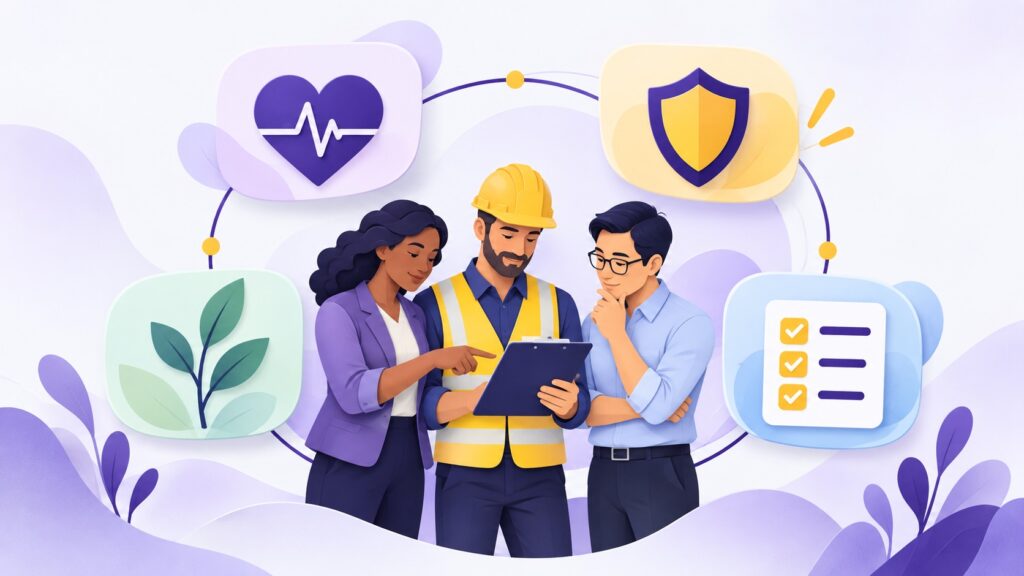
HSEQ stands for Health, Safety, Environment and Quality: four disciplines that work together to protect people, manage environmental impacts and improve products, services and processes.
Protect health
Protecting workers’ health and managing occupational health risks.
Prevent harm
Preventing injuries, incidents and unsafe conditions by identifying and controlling workplace risks.
Manage impacts
Managing environmental impacts, obligations, risks and opportunities.
Meet requirements
Ensuring that products, services and processes consistently meet applicable requirements.
HSEQ, HSE, EHS, QHSE, OHS: What’s the Difference?
The terminology may change between companies, industries and countries. The acronym is only the beginning.
Different Acronyms. One Integrated Challenge.
One operational event can cross Quality, Safety, Training, Compliance and Management Review.
Imagine an organization identifies a process deviation. Is it only a Quality problem? Not necessarily. The deviation could also create a Safety risk. It could require new training. It could generate a corrective action. It could reveal a compliance issue. It could change a risk assessment. And eventually, it could become information for management review.
One event can therefore move across multiple HSEQ processes. This is why managing HSEQ as separate information silos can become a limitation, and why an integrated HSEQ software platform is becoming the natural next step.
HSEQ Is Not Four Systems Working Side by Side
A truly integrated approach connects information across processes instead of treating each discipline as a separate silo.
Risk & Events
Risk Assessment, Incidents, Near Misses and operational evidence.
Audit & CAPA
Audits, Nonconformities, Corrective Actions and verified follow-up.
Compliance & Competence
Legal requirements, Training, Evidence, Objectives, KPIs and Management Review.
Who Manages HSEQ?
Titles differ, but the modern role increasingly requires the ability to connect people, risk, systems, evidence and decisions.
HSE Specialist
Technical and operational HSE support.
HSE / EHS Manager
Coordination, systems integration and decision support.
QHSE / HSEQ Manager
Integrated Quality, Health, Safety and Environment leadership.
EHS Director
Strategic governance, performance and organizational direction.
The exact responsibilities depend on the organization, sector, country and complexity of its operations. But modern HSE roles increasingly require something broader than technical knowledge alone.
What Skills Does an HSE Manager Need?
An effective HSE Manager combines technical competence, management-system thinking, data intelligence and human skills.
PEOPLE & CARE
The ultimate purpose of HSE management is not simply compliance. It is protecting people and creating the conditions in which they can speak up, learn, improve and work more safely.
Technical & Regulatory Knowledge
Occupational health and safety, environmental requirements, applicable legislation, standards and compliance.
Management Systems
ISO 45001, ISO 14001, integration with ISO 9001, objectives, processes, monitoring and continual improvement.
Risk Management
Hazard identification, risk assessment, control evaluation and management of change.
Auditing
Audit planning, objective evidence, conformity assessment, findings and follow-up.
Root Cause Analysis
5 Why, 6M / Ishikawa, Process FMEA and causal thinking.
Data Analysis & Systems Thinking
KPI, trends, weak signals, correlations and cross-process analysis.
Communication
Clear communication with workers, managers, executives and stakeholders.
Emotional Intelligence
Self-awareness, empathy, awareness of context and relationship management.
Active Listening
Listening to concerns, uncertainty, experience and weak signals.
Leadership & Influence
Credibility, engagement, decision support and safety leadership.
Change Management
Supporting people and processes through organizational, technological and regulatory change.
People Care
Trust, psychological safety, respect, attention to people and learning.
From HSE Specialist to HSE Manager
Technical knowledge alone does not necessarily define a managerial HSE role.
Technical & Operational Focus
Technical knowledge • Operational support • Risk analysis • Compliance activities • Monitoring • Evidence collection
Integrated & Strategic Focus
System integration • Coordination • Technical and regulatory competence • Strategic risk perspective • Data intelligence and systems thinking • Communication • Emotional intelligence • Active listening • Leadership and influence • People care • Change management • Performance management • Decision support • Continuous improvement
Can HSE Manager Competence Be Certified?
Yes. In Italy, professional competence can be assessed against a defined framework rather than relying only on a job title.
UNI 11720:2025, in force since 27 February 2025, defines the professional requirements for HSE professionals and identifies two profiles: HSE Specialist and HSE Manager.
The framework addresses knowledge, skills, autonomy and responsibility. For the HSE Manager, this means that professional competence goes beyond a job title: it can be assessed against a defined professional framework.
The managerial dimension of the role includes the ability to support organizational strategy, coordinate HSE activities, exercise leadership and operate with professional responsibility and ethics.
Professional Experience
Build relevant HSE experience and responsibility.
Knowledge & Skills
Develop technical, managerial and human competencies.
UNI 11720 Requirements
Compare your profile with the applicable professional requirements.
Competence Assessment
Complete the independent assessment, including written and oral examinations.
Professional Certification
Maintain and continue developing competence over time.
How to Become a Certified HSE Manager in Italy
Certification of competence should not be confused with simply attending a training course.
Certification of competence involves an independent assessment of the professional against defined requirements. Under the accredited certification route, the competence assessment includes written and oral examinations designed to evaluate not only theoretical knowledge but also the ability to deal with practical and complex HSE situations.
Accredited personnel certification is performed by certification bodies operating under UNI CEI EN ISO/IEC 17024 for the relevant UNI 11720:2025 scheme.
Candidates should therefore verify that the selected certification body is accredited for the relevant HSE personnel certification scope.
Important: Always verify the current accreditation status and scope directly through Accredia before selecting a certification body.
International HSE Qualifications: The NEBOSH Route
Alongside national competence-certification schemes, HSE professionals can also develop and demonstrate their knowledge through internationally recognised professional qualifications.
NEBOSH provides internationally recognised occupational health and safety qualifications used by professionals and organisations in many countries.
NEBOSH International General Certificate
A widely recognised qualification for managers, supervisors and people with health and safety responsibilities, as well as professionals beginning or developing a career in occupational health and safety.
NEBOSH Level 6 International Diploma
An advanced international qualification for Occupational Health and Safety Management Professionals, designed to develop the knowledge and practical capability required for senior health and safety responsibilities.
Build HSE Foundations
Develop core occupational health and safety knowledge and practical understanding.
Gain Experience
Apply HSE knowledge in real organizational and operational contexts.
Develop Advanced Competence
Progress toward advanced professional knowledge through qualifications such as the NEBOSH Level 6 International Diploma.
Professional Recognition
Use qualifications and experience to support relevant professional membership and career-development pathways.
But Certification Is Only the Beginning
The daily challenge is applying those competencies inside a real organization.
Risk
What are our most significant risks?
Effectiveness
Are corrective actions really effective?
Compliance
Which legal requirements are changing?
Competence
Who needs training?
Assurance
What did our audits identify?
Signals
Where are incidents and unsafe conditions increasing?
These questions are hard to answer when data lives in spreadsheets, emails and disconnected tools. This is where HSEQ software turns competence into daily, measurable practice: near-miss and incident reporting, corrective action tracking, legal register and compliance and safety KPI dashboards.
From HSEQ Skills to HSEQ Decisions
An HSEQ professional does not manage acronyms. They manage information and decisions.
The stronger these connections become, the more useful the management system becomes.
HSEQ Software: One Professional, Many Processes, One Digital Thread
Instead of treating HSEQ information as isolated records, HSEQ management software lets different processes become part of the same digital ecosystem.
Risk Assessment
Identify, evaluate and follow risk.
Incident Management
Capture incidents, near misses and field evidence.
Audit & CAPA
Connect findings, root cause, actions and evidence.
Training & Compliance
Connect competence, requirements and follow-up.
What to Look for in HSEQ Management Software
Whatever solution you evaluate, these six criteria separate a connected HSEQ system from a collection of digital forms.
One system, not four silos
Risk, incidents, audits, corrective actions, training and compliance share the same records and the same evidence.
Fast field reporting
Workers and supervisors can report incidents, near misses and unsafe conditions in minutes, from the field.
Closed-loop corrective actions
Finding, root cause, action, owner, deadline and verification of effectiveness, all tracked in one place.
Compliance and competence
Legal requirements, training records and audit evidence ready for ISO 45001, ISO 14001 and ISO 9001.
KPIs from live data
Leading and lagging indicators and management-review reports built from real data, not rebuilt every month in spreadsheets.
Forms that fit your organization
Forms and workflows adapted to your sector, sites and processes, not the other way round.
From Connected HSEQ Data to Predictive Prevention
The evolution of the HSE profession also changes the role of technology.
An HSE Manager increasingly needs to understand not only individual events, but also the relationships between observations, unsafe acts and conditions, audits, corrective actions, training, compliance requirements and risk information.
This is the idea behind SpeakUp4Safety Care: connecting HSEQ signals while keeping people at the center of the system.
The objective is not to replace the HSE Manager. It is to strengthen professional judgement. This is where the competence matrix becomes practical: technical knowledge, data intelligence, communication, emotional intelligence, leadership and care for people come together in the decision-making process.
Whatever You Call It, Your Management System Should Work as One
HSE. EHS. HSEQ. QHSE. SHEQ. The acronym may change. The real challenge does not. Organizations need people with the right competencies, processes capable of working together and information that can support better decisions. Start with your own forms, your own processes and your own data.