SuFS Vision — concept in development. A preview of SpeakUp4Safety’s vision for hands-free safety reporting, shaped through conversations with the people who work in the field every day.
You see a hazard. You describe it aloud. What if you could start a safety report without using your hands?
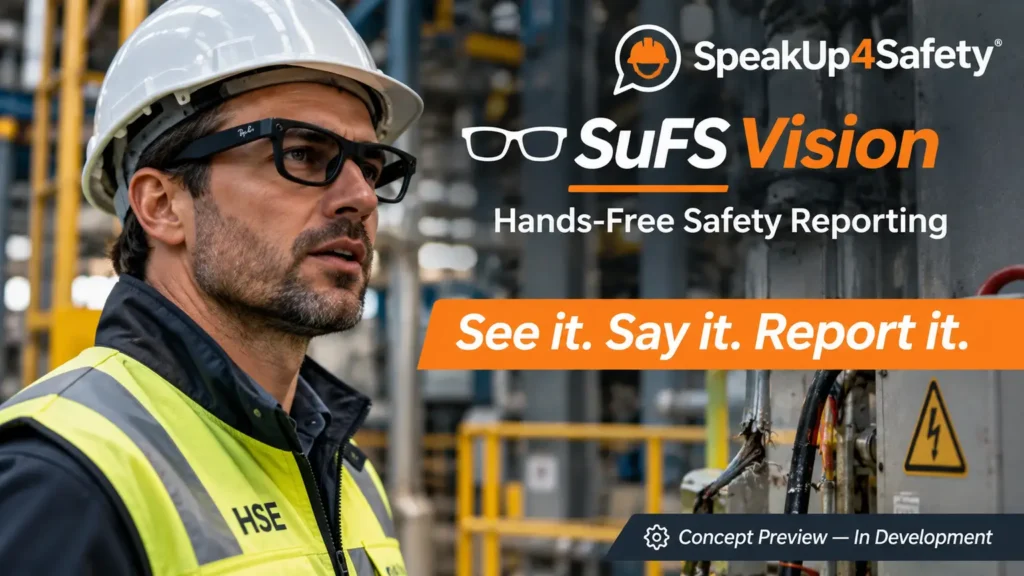
That question is at the heart of SuFS Vision. The concept explores how smart glasses could help EHS and HSE professionals describe an observation and preserve its context, making the first step in reporting more immediate. The accompanying image offers a visual preview of that ambition.
See it. Say it. Report it.
What is hands-free safety reporting?
Hands-free safety reporting means capturing an observation through an input method such as voice, with less need to type or hold a device. For SuFS Vision, the idea is to explore smart glasses as a possible interface between what a person observes and the information needed for a useful report.
The objective is straightforward: make it easier to describe an issue while its details are still fresh. A useful observation needs context. What was seen? Where was it? Which task or piece of equipment was involved? What needs someone’s attention?
The concept focuses on helping people communicate those details, with professional judgment and review remaining central.
Smart glasses for safety reporting: the SuFS Vision concept
Think about the gap between noticing a condition and documenting it. A person may need to reach for a phone, find the right form, type a description, and explain the location. SuFS Vision asks whether voice-led interaction could simplify that initial step in suitable circumstances.
Consider an illustrative inspection scenario: an HSE professional notices a damaged cable enclosure from a safe position. A spoken description could identify the equipment, the location, and the visible condition. A reporting workflow could then help turn those observations into a draft for review.
This is a possible use case, not a demonstration of a released SuFS Vision feature. Reporting would still fit around the site’s established response procedures. Hands-free interaction should never be an invitation to keep working through a hazard or divide attention during a safety-critical task.
How the proposed hands-free reporting workflow could work
The proposed experience starts with a simple sequence:
- Observe: identify something that needs attention during an inspection or other appropriate activity.
- Describe: explain the observation aloud, including the relevant context.
- Review: check that the resulting record accurately reflects what was observed.
- Follow up: pass the reviewed information into the organisation’s established reporting and action process.
These steps describe the direction we want to explore as the concept develops.
For the people receiving a report, clarity matters as much as convenience. A short description such as “there is a problem near the machine” leaves questions unanswered. Identifying the machine, location, and visible condition would make that observation more useful. Exploring how to prompt for the right details is part of the design challenge.
Developing SuFS Vision for EHS teams
A useful concept needs scrutiny from the people who might use it. For SuFS Vision, the practical questions include:
- Field conditions: where would voice input be useful, and where would noise or the task itself make another method preferable?
- Record quality: how would users check, correct, and confirm their observations before submission?
- Workplace suitability: what device requirements and site restrictions would need to be assessed?
- Recording boundaries: what information should be captured, who should be able to access it, and how would recording be made clear to people nearby?
- Follow-up: how would a report reach the appropriate person without creating another disconnected inbox?
Practical testing and feedback would help establish which approaches work well and what needs improvement.
What would make a field trial useful?
A future trial could compare the proposed voice-led workflow with the way a team records observations today. The aim would be to learn whether the concept makes reporting easier while preserving the information reviewers need.
Useful questions for a trial would include:
- Can the person capture the location and equipment reference clearly?
- Does the draft preserve the words and meaning of the observation?
- How often does a reviewer need to ask for missing details?
- Can the user correct a mistaken word before submitting the report?
- Does the interaction remain practical in the intended work setting?
Time to complete a report could be one measure, alongside completeness, correction effort, and user feedback. A faster report would have little value if it left out essential context. Testing should also identify when a conventional form is the better choice.
These are proposed evaluation questions, not published trial results. They offer a practical starting point for discussing SuFS Vision with EHS teams and deciding what evidence would be needed before wider use.
Help shape the future of hands-free safety reporting
The strongest feedback is a real example. An inspection team may have different needs from a maintenance team. A quiet work area may present different challenges from a noisy production environment. Understanding those differences can help decide which interactions deserve development and testing.
We want to hear where hands-free reporting would remove a practical obstacle, what information must never be lost, and what would make the process easier to trust. Feedback about situations where it would not help is equally valuable.
Learn more about SpeakUp4Safety and share the reporting challenges your team encounters.
Explore SpeakUp4Safety reporting forms
To explore structured reporting today, visit the Unsafe Act and Condition form for hazard observations, or the Accident Report form for incident reporting. Both links lead to personal-account sign-in or registration. These are existing SpeakUp4Safety forms; the hands-free SuFS Vision experience remains a concept in development.
SuFS Vision: frequently asked questions
What stage is SuFS Vision at?
SuFS Vision is a concept in development. We are sharing the direction of the project and inviting EHS and HSE professionals to help shape it through practical feedback.
Does the image confirm a partnership or supported device?
No. The image is a concept illustration. It does not establish a partnership with a glasses manufacturer or confirm device compatibility, certification, or suitability for a particular workplace.
How can I contribute?
Describe a situation where hands-free safety reporting could make a meaningful difference. Include the setting, the reporting difficulty, and the information you would need to capture. Please leave out confidential workplace details.
For more information about SuFS Vision, contact alessandro@speakup4safetyapp.com.
SuFS Vision — concept in development. See it. Say it. Report it.