LEGAL REGISTER SOFTWARE · REGULATORY COMPLIANCE · ISO 14001 & ISO 45001
Can you demonstrate not only which legal requirements apply, but how your organization evaluates them, assigns responsibility and maintains evidence of compliance?
Legal register software for ISO 14001 and ISO 45001 should do more than maintain a list of laws. A robust compliance workflow connects compliance obligations with applicability, accountable owners, deadlines, communication and objective audit evidence, creating a reviewable history of decisions and actions.
SpeakUp4Safety Legal & Regulatory Management is designed around that complete flow. It combines a controlled Legal Register, AI-assisted document review, structured obligations, site-specific applicability, the Requirements Logbook, communication and acknowledgment, and traceable follow-up.
1. Legal register software starts with a controlled regulatory source
A reliable compliance process begins with the source itself. Record the legal act, issuing authority, jurisdiction, issue and effective dates, legal status, source reference and the version used by the organization.
SpeakUp4Safety can associate the Legal Register record with controlled documents. Document metadata can include the file name, version, hash, current-version status and OCR information. Therefore, the regulatory source remains connected to the structured compliance record rather than being reduced to a spreadsheet row.
2. Use AI to support regulatory verification — not replace professional judgment
Finding a regulation is only the first step. Teams also need to determine whether the uploaded reference is current, what changed and which parts require professional attention.
SpeakUp4Safety can use AI-assisted analysis to structure regulatory information for review. The workflow can retain verification status, official status, the latest reference, version and effective dates, together with a summary of material changes and the sources used during analysis.
AI can accelerate document review and highlight relevant information. A qualified person still validates applicability, interpretation, obligations and the final compliance decision.
3. Turn regulations into operational compliance obligations
An organization does not manage legislation only at document level. It manages the individual obligations created by that legislation.
SpeakUp4Safety can structure each obligation around the relevant article or paragraph, an operational summary, the evidence required, control type, frequency, triggering conditions, criticality, owner and validation status. AI-assisted drafts can also propose structured obligations for professional review before they enter the operational workflow.
Source traceability
Keep the obligation connected to its legal register record and source provision.
Evidence required
Define what record, inspection, document, training or other evidence should support the obligation.
Frequency & triggers
Describe periodic controls and events that should trigger a new review or action.
Ownership & criticality
Assign accountability and distinguish obligations that require closer attention.
This is the point where a static legal register becomes an operational regulatory compliance system.
4. Assess legal applicability site by site
The same regulation does not necessarily apply in the same way to every location, process or activity. A multi-site organization needs to document not only whether a requirement applies, but also why.
SpeakUp4Safety supports site-specific applicability records with the applicability decision, rationale, affected processes, owner, assessment date and next review date. This creates a traceable response to a fundamental auditor question:
Why does this legal requirement apply to this site, process or activity?
That distinction is particularly useful where organizations operate multiple plants, business units or jurisdictions.
5. Connect legal obligations to the Requirements Logbook
The Legal Register defines the regulatory source and the obligations derived from it. The Requirements Logbook manages what the organization needs to do next.
Link the legal source and validated obligation to an operational requirement with site, status, due date, frequency, responsibility and supporting records.
SpeakUp4Safety can link a Legal Register record and a specific legal obligation directly to a Requirement Logbook entry. This keeps the relationship between regulation, obligation and operational follow-up visible instead of creating disconnected compliance lists.
The Requirements Logbook can then manage information such as site, requirement type, topic, application date, status, due date, notes, supporting PDF records and frequency.
6. Communicate the requirement and capture acknowledgment
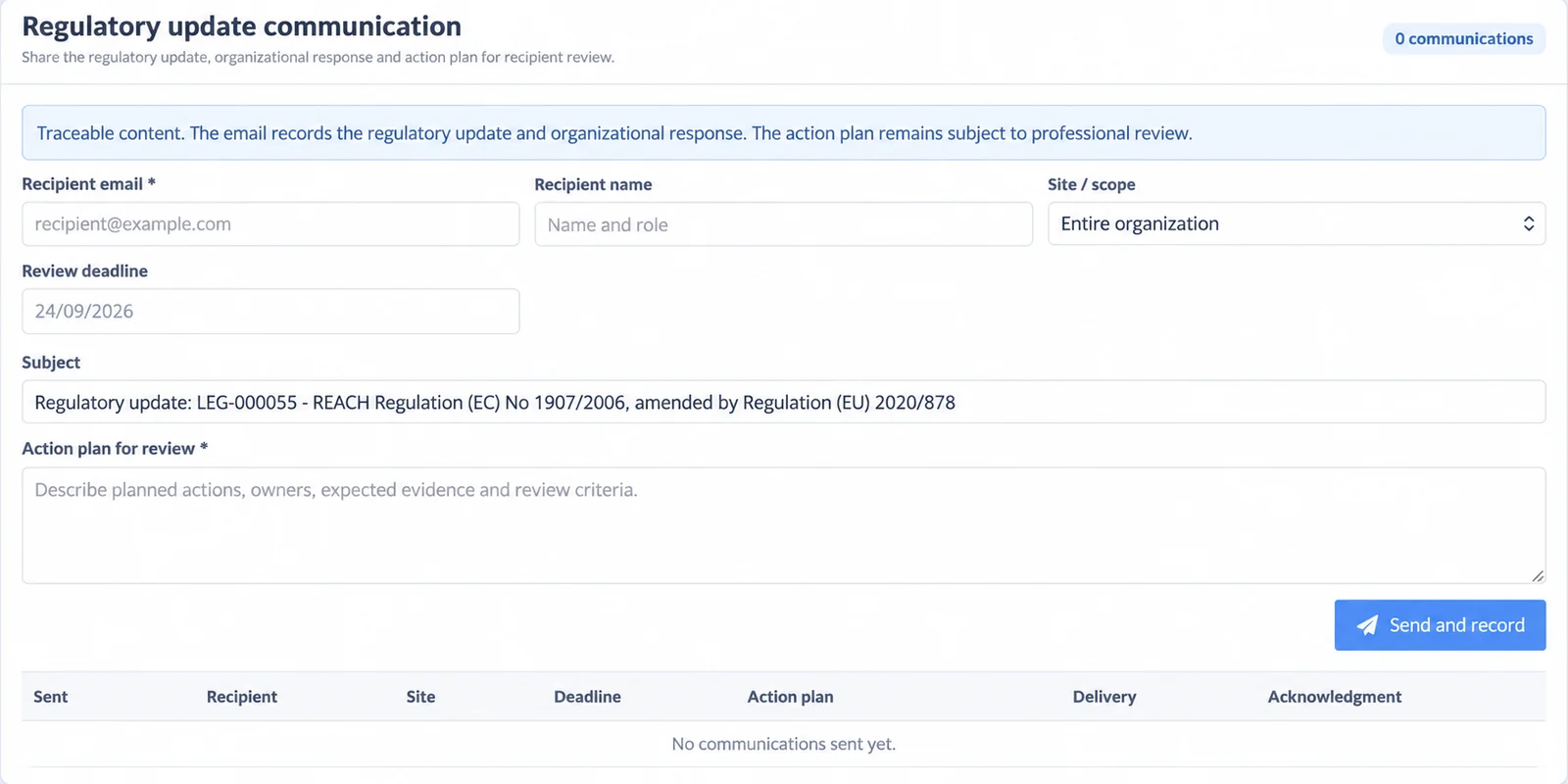
Once the obligation and required action are clear, the relevant business functions need the right information. Route the requirement to the people who can implement it, such as EHS, operations, maintenance, HR, procurement or site management.
The communication should state what changed, why it matters, the affected activity, the required action and the expected timing. The regulatory source and the operational requirement should remain connected so that recipients can understand the context behind the request.
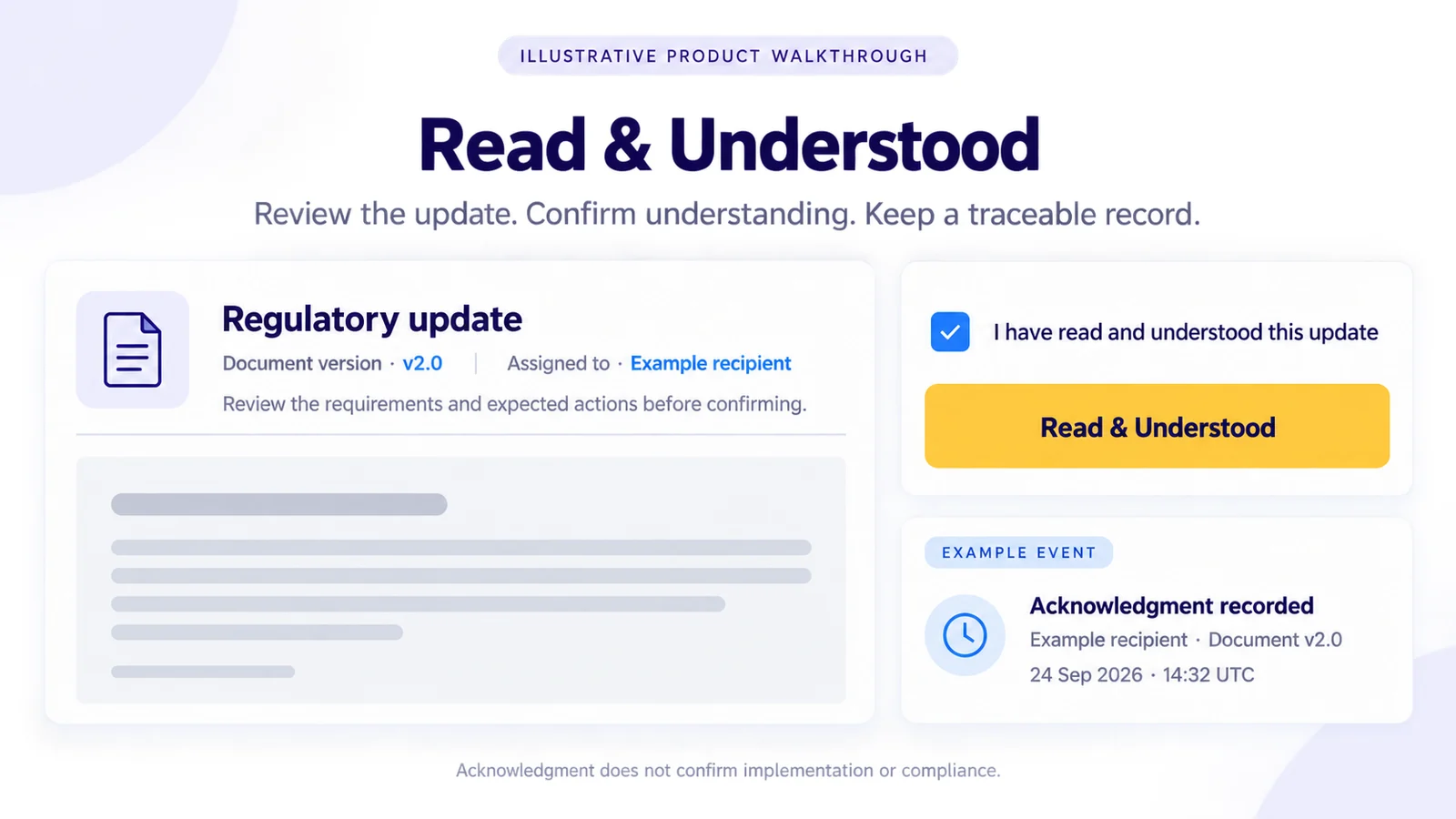
Read & Understood is an acknowledgment, not a compliance decision
Where the workflow uses “Read & Understood / Letto e capito”, the confirmation records that the recipient declares that the information has been read and understood. It should remain tied to the relevant document or communication record.
However, acknowledgment does not prove that an action has been completed, that competence has been demonstrated or that the organization is compliant. Those conclusions require the appropriate implementation evidence and professional review.
7. Build an audit trail from regulation to evidence
A reviewer should be able to reconstruct the compliance story. Which source was reviewed? Which obligation was identified? Why was it considered applicable? Who owned the requirement? What action was taken? Which evidence supports the result?
SpeakUp4Safety includes an audit-log structure linking actions to the Legal Register, individual obligations and Requirements Logbook records. That history helps preserve who performed an action and when it occurred.
For an audit sample, follow one requirement end to end:
- Open the controlled regulatory source.
- Review the identified obligation.
- Show the site-specific applicability decision and rationale.
- Identify the owner and operational requirement.
- Review due dates, communication and acknowledgment where applicable.
- Open the implementation evidence.
- Show the recorded follow-up and audit history.
This evidence can also support your ISO audit management workflow.
8. Keep compliance evaluation separate from communication
A sent message is evidence of communication. An acknowledgment is evidence of acknowledgment. Neither should automatically become evidence that the legal obligation has been fulfilled.
Compliance evaluation should consider the obligation, the required evidence, the actual implementation and any open gaps. If evidence is missing, record the limitation and assign follow-up rather than assuming a positive outcome.
This separation makes the workflow more defensible because regulatory information, operational execution and the final professional judgment remain distinguishable.
9. Practical example: from a regulatory update to audit evidence
Consider a regulatory update that changes an equipment inspection requirement at one manufacturing site.
First, EHS records the authoritative source and reviews the new version. AI-assisted analysis highlights the relevant change, while a competent person validates it. The team then creates the specific inspection obligation and records the evidence expected.
Next, the applicability assessment identifies the affected site and process. The requirement is linked to the Requirements Logbook, assigned to maintenance and given a due date. The responsible manager receives the relevant information and acknowledges it.
Finally, maintenance updates the inspection plan and performs the required control. The resulting inspection record becomes implementation evidence. The audit history preserves the sequence from source review to action and follow-up.
That traceable chain is the real value of digital legal register software.
How AI-powered EHS compliance software can help
AI is most useful when it reduces repetitive review work without hiding the source or replacing accountable decisions. In SpeakUp4Safety, AI-assisted regulatory analysis can help structure references, highlight changes and propose obligation drafts for professional validation.
The original source should remain accessible. In addition, users should review jurisdiction, effective dates, exceptions and site-specific conditions before accepting any compliance interpretation.
Therefore, the goal is not autonomous legal decision-making. The goal is faster analysis, clearer traceability and better-supported human decisions.
Legal Register Software vs Excel
A spreadsheet can list legal requirements, but a structured compliance workflow can also show who owns each obligation, who received the information, what actions were taken, which deadlines apply and what evidence is available during an audit.
For ISO 14001 and ISO 45001 management systems, this traceability helps transform the legal register from a static list into an active process for managing compliance obligations and audit evidence.
Legal register software: frequently asked questions
What is legal register software?
Legal register software organizes applicable regulatory sources and helps connect them with operational obligations, responsibilities, deadlines, evidence and review. The exact workflow depends on the organization and jurisdiction.
How is a legal register different from a Requirements Logbook?
The Legal Register records the regulatory source and the obligations derived from it. The Requirements Logbook manages the operational requirement, including follow-up information such as status, due date, frequency and supporting records.
Can AI determine whether a law applies to my company?
AI can assist document review and highlight relevant information, but applicability and legal interpretation should be validated by a competent person using the authoritative source and the organization’s actual activities and jurisdiction.
Can SpeakUp4Safety manage different sites?
The Legal & Regulatory data model supports site-specific applicability, rationale, affected processes, ownership and review dates, which can help multi-site organizations document how a requirement applies in different locations.
Does Read & Understood prove compliance?
No. It records an acknowledgment of the shared information. Compliance still depends on the applicable obligation, implementation and sufficient evidence.
Standards and further reading
Consult the applicable standard edition and authoritative legal sources for your organization’s activities and jurisdiction. Software supports the management process; it does not guarantee legal compliance or certification.