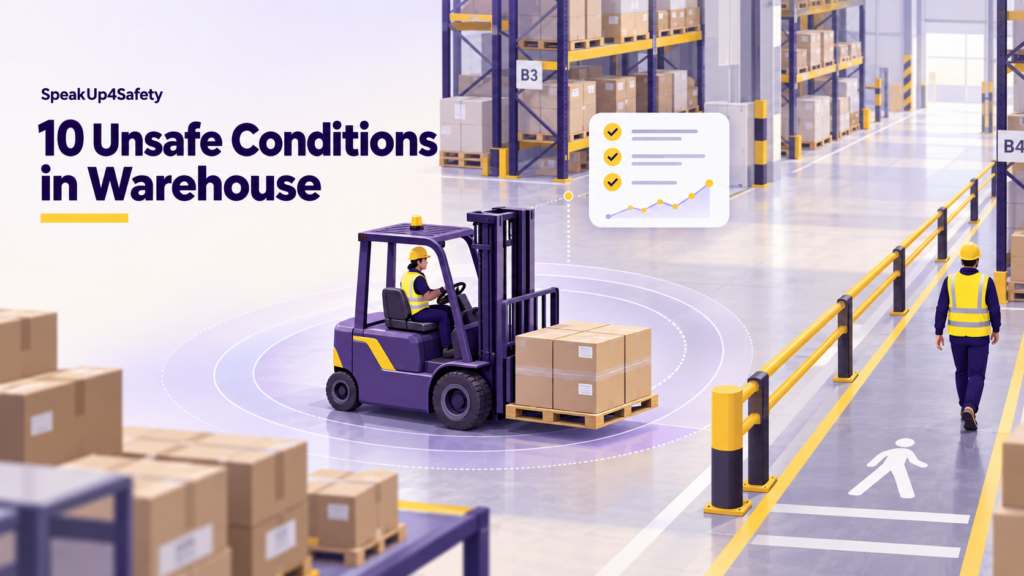
Identifying unsafe conditions in warehouse operations is only the first step. Effective prevention also means proving that the controls protecting people continue to work when they are needed.
Warehouses bring people, forklifts, goods and equipment into constantly changing spaces. This guide examines ten unsafe conditions, with a closer look at forklift–pedestrian interaction, AI safety systems and independent periodic critical-control verification.
- Identify → Control → Verify
- 10 unsafe conditions
- Evidence and corrective action
- Trends and recovery plans
10 unsafe conditions in warehouse management
Keep the familiar inspection checklist, but strengthen the question behind each item: what prevents harm, and what evidence shows that the control is effective?
1. Forklift–pedestrian interaction
Shared routes, blind spots and uncontrolled crossings expose people to moving vehicles.
2. Poor lighting
Shadows and inadequate visibility make people, obstacles and signs harder to see.
3. Damaged racking
Impact damage and structural deformation can undermine storage integrity.
4. Unsecured forklift loads
Unstable or poorly positioned goods can fall during lifting or transport.
5. Blocked emergency access
Stored materials can obstruct escape routes or access to fire equipment.
6. Slippery or damaged floors
Spills, debris and uneven surfaces affect both pedestrians and vehicles.
7. Faulty equipment
Defective equipment and failed protective devices weaken intended safeguards.
8. Unidentified hazardous materials
Missing labels and unsuitable storage make handling and emergency response harder.
9. Inadequate ventilation
Insufficient ventilation can allow contaminants to accumulate.
10. Damaged electrical installations
Deteriorated cables, sockets and connections need prompt attention.
Forklift–pedestrian interaction: control the shared space
Receiving, picking, inventory checks and maintenance can bring people into forklift operating areas. Racking, doorways, junctions and blind spots make these interactions more difficult to manage. A route that appears safe during a quiet inspection may behave very differently during peak activity.
Technology does not replace warehouse traffic management
Start with the layout and the way work is organised. OSHA’s guidance on pedestrian traffic describes separation measures including walkways and barriers. Translate these principles into a traffic plan suited to the warehouse.
Build the first layer of prevention
- Separate pedestrian and vehicle routes physically wherever practicable.
- Define pedestrian walkways, controlled crossings and access points.
- Manage blind spots, doors and intersections.
- Set suitable speed limits, right-of-way rules and clear signs.
- Review the plan when layouts, equipment or operating patterns change.
The NIOSH hierarchy of controls prioritises elimination, substitution and engineering controls ahead of administrative measures and personal protective equipment. For forklift pedestrian safety, reducing unnecessary shared-space exposure should come before relying on warnings or individual vigilance alone.
AI pedestrian detection and forklift collision avoidance
Computer vision, proximity detection and automatic speed reduction can add protection to a well-designed traffic-management system. Their effectiveness depends on the selected equipment, configuration and operating environment.
KiwiEye by Kiwitron
An AI camera-based detection system for recognising people and obstacles. Depending on the installation and integration, warnings and speed-reduction functions can support collision prevention.
ELOvision by ELOKON
A tagless, AI camera-based pedestrian-detection solution. Warning zones, alarms and supported automatic slowdown configurations provide additional layers of protection.
Blaxtair Pedestrian Detection
Embedded AI cameras identify and locate people around machinery. The wider ecosystem includes checklist and zoning functions, with event analysis available through Blaxtair Connect.
Who verifies the control?
Once an organisation relies on pedestrian detection or automatic slowdown to manage a significant risk, the next question is straightforward: how do we know that the system continues to function correctly?
Operator pre-use checks and independent periodic verification
An operator pre-use check is an important first level of control. It can cover brakes, lights, warning devices, forks and other items specified for the vehicle. Some digital fleet systems also require completion of a checklist before use.
But a completed checklist does not, by itself, demonstrate that every safety function performs as intended. Repetitive checks can become declarative unless they are supported by clear criteria, appropriate tests and follow-up.
Operator pre-use check
Confirms the vehicle’s condition before operation, identifies defects and provides the first opportunity to stop unsafe equipment being used. It remains part of routine operational responsibility.
Independent periodic critical-control verification
Provides an additional level of assurance. A competent supervisor, EHS professional or internal or external auditor, separate from the routine operator check, verifies and records whether the defined critical control actually performs as intended.
What should the verification establish?
- Pedestrian detection performs within the coverage and conditions specified for the installation.
- Warning and danger zones match the approved configuration.
- Visual and audible warnings activate as expected.
- Automatic slowdown operates correctly where it is an installed and supported function.
- Cameras and sensors are free from obstruction, damage or other relevant faults.
- Settings have not been altered without authorisation.
- Events are recorded where logging is part of the system.
- A failed check triggers reporting, responsibility and corrective action.
Set the verification frequency from the risk assessment, control criticality, manufacturer’s instructions, operating experience and previous findings. A change in configuration, repeated fault or repair may justify an additional verification. There is no single interval suitable for every application.
Checking that a safety control exists is not the same as proving that it works.
Define the expected performance, record the observed result and retain the evidence. This is the difference between completing a form and establishing control assurance.
What happens when a control fails?
A verification only creates value when an unacceptable result activates a defined response. Apply the necessary immediate restrictions, including taking unsafe equipment out of service where appropriate, and escalate the finding to the responsible person.
Detection → Evidence → Reporting → Responsibility → Corrective Action → Verification → Closure
Capture the vehicle or asset identifier, location, date, verifier, test method, expected response, actual result and supporting photographs or records. Assign an owner and due date, then confirm that the action restores the intended control before closing the finding.
With SpeakUp4Safety Audit Management, an organisation can structure a Forklift Safety Control Inspection Form for periodic verification. The workflow can capture evidence, record a failed control as an unsafe condition, assign corrective actions and monitor their closure.
The purpose is to verify and document the effectiveness of the technology on which the organisation relies. The inspection workflow complements the safety system installed on the forklift.
From control verification to predictive risk management
A single verification shows whether a control works today. A structured sequence of verifications can reveal whether its effectiveness is stable, improving or degrading over time.
Repeated failures, increasing anomalies, recurring corrective actions and longer recovery times can indicate deterioration. Interpret these signals alongside inspection coverage, exposure and data quality: more reported findings can also reflect better reporting or more frequent checks.
In SpeakUp4Safety, structured verification data can feed the Predictive H&S Dashboard and PRISMA to support the assessment of control trends and emerging risk signals. Where deterioration is identified, a Recovery Plan connects the signal to accountable action and subsequent monitoring.
Is this critical control stable, improving or degrading?
Verify → Trend → Detect Degradation → Predict Risk → Recovery Plan → Monitor
The objective is to identify deterioration in the risk profile before it contributes to an event. Predictive safety does not mean knowing with certainty when an accident will happen.
The other unsafe conditions: apply the same discipline
The same logic applies across the warehouse: identify the condition, implement the appropriate control and verify that the action has worked.
2. Poor lighting
Insufficient lighting makes obstacles, signs, people and moving equipment harder to recognise. Check actual working areas, shadows and transitions between zones, including conditions during different shifts. Correct defective lighting and verify that visibility is adequate for the task.
3. Damaged racking
Vehicle impacts, deformation and structural damage can compromise racking integrity. Record the damage, protect the affected area and obtain a competent assessment. Follow the resulting restrictions and repair requirements, then verify that the condition has been made safe.
4. Unsecured forklift loads
Unstable or incorrectly positioned loads can fall during lifting or transport. Consider load weight, dimensions, stability, handling height and the operator’s view. Check that the load and handling method are suitable for the equipment before movement begins.
5. Blocked emergency exits or fire equipment
Temporary storage can obstruct escape routes or prevent access to emergency equipment. Restore access promptly and address the storage practice that caused the obstruction. Repeated checks should establish whether routes remain clear throughout operations.
6. Wet, slippery or damaged floors
Leaks, spills, debris, holes and uneven surfaces create hazards for pedestrians and vehicles. Protect the affected area, remove the contamination or repair the defect, and address the cause. A warning sign alone does not complete the corrective action.
7. Faulty equipment
A guard or warning device that is present but does not work cannot provide its intended protection. Report defects and prevent unsafe use. After repair, confirm that the equipment and relevant protective functions operate correctly before authorising return to service.
8. Unlabelled or improperly stored hazardous materials
Missing labels, unidentified containers and unsuitable storage increase the potential for exposure, misuse and ineffective emergency response. Verify identification, access to relevant safety information and storage compatibility against the materials actually present.
9. Inadequate ventilation
Some warehouse activities can generate vapours, dust or other airborne contaminants. Confirm that ventilation is suitable for the substances and operating conditions. The presence of a ventilation system is not evidence that it adequately controls exposure; assess performance and arrange measurements where needed.
10. Damaged electrical installations and outlets
Deteriorated cables, sockets, panels and connections need to be identified and made safe. Prevent access or use as appropriate and arrange assessment and repair by competent personnel. Close the finding only after the repair and required verification have been completed.
Why reporting unsafe conditions matters
Counting reports is a starting point. A mature warehouse safety process also asks where conditions recur, which controls fail most often, how long corrective actions take and whether the action removes the underlying cause.
Understand recurrence
Connect repeat findings to locations, assets, shifts and control types. Look for patterns that individual reports cannot explain.
Verify closure
Distinguish administrative completion from restored control effectiveness. Retain the evidence supporting closure.
Review the trend
Use the SpeakUp4Safety H&S Dashboard to support prioritisation, follow-up and management review.
Inspection → Unsafe Condition → Evidence → Action → Closure → H&S Dashboard → Trend Analysis
The value comes from understanding where the control system is weakening early enough to act. Digitalising a checklist is useful when it improves this chain of decisions.
The auditor’s question
The next time a new camera, proximity sensor or warning system is presented as a safety improvement, ask for more than confirmation that it is installed.
Warehouse safety FAQ
What are unsafe conditions in warehouse operations?
They are conditions that expose people to harm, such as uncontrolled forklift–pedestrian interaction, poor lighting, damaged racking, unstable loads, blocked exits, slippery floors, faulty equipment, unidentified hazardous materials, inadequate ventilation and damaged electrical installations.
Can AI pedestrian detection replace physical separation?
AI systems provide an additional layer of protection. Start with the traffic plan, reduce unnecessary interaction and separate people from vehicles wherever practicable. Select and verify technology for the actual operating environment.
How is independent verification different from a pre-use check?
A pre-use check is the operator’s routine check before operation. Independent periodic verification provides an additional, documented assessment of whether a defined critical control performs as intended, carried out by a competent person separate from the routine check.
How often should forklift safety controls be verified?
Set the interval using the risk assessment, manufacturer’s instructions, control criticality, operating conditions and previous results. Review the interval after failures, repairs or relevant changes instead of applying one universal frequency.
What can predictive safety tell us?
Structured verification data can reveal repeated failures and deteriorating control performance. PRISMA and the Predictive H&S Dashboard support assessment of these signals and Recovery Plans; they do not establish when an accident will occur with certainty.
Turn warehouse findings into verified improvement
Connect inspections, unsafe-condition reporting, corrective actions and control trends in one evidence-based workflow.