Incident reporting best practices are the rules and workflows that ensure every incident report is timely, accurate, and actionable. In other words, reporting should trigger investigation, corrective actions (CAPA), and measurable learning—so problems do not repeat.
What to report OSHA & ISO 45001 Common mistakes Software workflow
Workplace safety isn’t just about helmets and drills; it’s about reporting incidents quickly and using that data to prevent recurrence. Therefore, incident reporting best practices focus on capturing the right details, preserving evidence, and driving corrective actions. Incident reporting is the process of documenting any event that could harm people, equipment, or the environment—including minor injuries, near misses, and serious accidents.
So why is incident reporting more important than ever? In fast-paced workplaces, small issues can escalate quickly if ignored. For this reason, tools like SpeakUp4Safety help teams capture, track, and resolve incidents using mobile reporting and digital tracking, eliminating paperwork delays.
In this guide, you’ll learn what incident reporting is, what standards expect, the best practices to apply, and the common mistakes to avoid. Additionally, you’ll see how digital workflows improve report quality and closure discipline.
A modern incident reporting software ensures every report leads to investigation, corrective actions, and measurable learning. Therefore, if you want a complete workflow, start here:
What Is Incident Reporting and Who Is It For?
Incident reporting isn’t just about injuries. In practice, it includes close calls, unsafe behaviors, property damage, and environmental events. As a result, strong reporting captures risk signals before harm occurs.
What typically qualifies as an incident?
- Physical injuries or illnesses at work
- Near misses (e.g., falling object narrowly missing someone)
- Unsafe acts or unsafe conditions (e.g., bypassing PPE, missing guards)
- Property or equipment damage
- Environmental hazards or spills
Who is responsible for incident reporting?
Front-line employees, supervisors, and safety officers all play a role. Ultimately, incident reporting works best when everyone participates and reporting is easy.
Why report at all?
Reporting is essential because it helps: first detect hidden risks, then trigger corrective actions, and finally prevent recurrence.
- Identify hidden risks before they become serious
- Prevent future problems through corrective actions (CAPA)
- Support legal and insurance processes with proper documentation
- Meet compliance standards and reduce penalties risk
Incident Reporting Standards and Requirements
Incident reporting isn’t only a best practice; it is also a requirement in many jurisdictions. Moreover, knowing global and local standards helps organizations stay compliant and improve safety culture. Below are the key frameworks you should understand.
OSHA (U.S.)
OSHA requires timely reporting of serious injuries and fatalities. Although OSHA applies to the U.S., many organizations use it as a reference for clear and timely incident reporting.
Key reporting windows:
- Fatalities must be reported within 8 hours
- Serious injuries must be reported within 24 hours
ISO 45001 (International)
ISO 45001 supports a structured safety management system that expects incident and near miss handling to drive improvement. Therefore, many organizations use ISO 45001 to strengthen reporting, investigation, and prevention workflows.
Focus areas include:
- Structured incident logging and documented information
- Root cause analysis to prevent recurrence
- Corrective and preventive actions (CAPA)
Italy: D.Lgs. 81/08 (Testo Unico)
D.Lgs. 81/08 defines obligations for prevention, reporting, and documentation in Italian workplaces. Consequently, consistent incident records and updated risk assessments are essential to avoid fines and protect workers.
- Immediate reporting of serious incidents to local health authorities (ASL) when required
- Maintenance of incident records and risk assessment updates
Common Mistakes to Avoid in Incident Reporting
Even with good intentions, common errors reduce the effectiveness of safety programs. Therefore, watch for these gaps and fix them early.
- Ignoring near misses: when a near miss isn’t reported, the risk stays hidden. Instead, treat it as an early warning.
- Vague descriptions: “An incident happened” is not actionable. For that reason, request specific context (task, equipment, sequence).
- Skipping follow-ups: the report is only the start. Consequently, value comes from investigation + CAPA closure.
- Complex processes: long forms discourage reporting. Therefore, keep reporting simple and mobile-friendly.
In short: eliminate friction, improve quality, and close actions with evidence.
Put incident reporting into practice: explore SpeakUp4Safety EHS management software to connect observations, incident records and corrective actions. Compare available plans.
Incident Reporting Best Practices (Software-Enabled Workflow)
Traditional paper reporting often leads to missing details and delayed submissions. Instead, use a workflow that ensures speed, consistency, and follow-through.
Best practice 1: Make reporting immediate and easy
First, reduce barriers. Therefore, use a short form, clear categories, and minimal typing—especially for frontline teams.
Best practice 2: Capture evidence at the source
Next, collect photos, videos, or voice notes on-site. As a result, the investigation starts with stronger facts and fewer assumptions.
Best practice 3: Standardize fields and classifications
Moreover, consistent formats reduce missing data. Consequently, investigations and CAPA actions become faster and easier to compare across sites.
Best practice 4: Protect privacy and encourage participation
In addition, people report more when they feel safe. Therefore, support private or anonymous reporting where appropriate and limit access by role.
Best practice 5: Link reports to investigation and CAPA
Finally, connect each report to investigation, root cause analysis, and corrective actions. As a result, reporting becomes prevention—rather than documentation only.
To strengthen investigation quality, see: Root Cause Analysis for Workplace Safety . Additionally, to improve closure discipline, see: Corrective Action Plan (CAPA) guide .
Tips to Improve the Quality of Each Incident Report
Not all reports are equal. However, higher-quality reports reduce investigation time and improve prevention decisions. Use the checklist below to strengthen consistency.
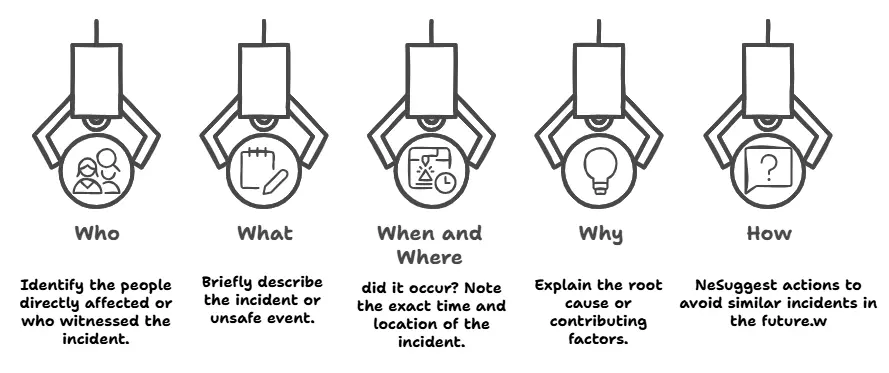
Moreover, structured reporting improves evidence, investigation speed, and audit readiness.
Report-quality checklist
- Operational details: who, when, where, task/activity, equipment involved.
- Evidence: photos/videos/voice notes whenever possible.
- Structured fields: dropdowns and checkboxes to reduce ambiguity.
- Historical context: link to similar incidents in the same area or hazard category.
- Preventive suggestion: require “how could this have been prevented?” to capture frontline insight.
- Cause selection: standard cause categories to support grouping and trend analysis.
SpeakUp4Safety: Incident Reporting Software That Drives Closure
Reporting workplace incidents shouldn’t be a burden. Therefore, SpeakUp4Safety keeps reporting fast and mobile-friendly while supporting investigation, CAPA, and audit-ready traceability.
What teams can do with mobile reporting
- Submit reports quickly from the field
- Upload photos, videos, or voice notes
- Use structured forms that reduce missing information
Reports are stored securely, searchable, and accessible to safety managers. In addition, real-time alerts speed response times, while privacy options encourage honest reporting.
For trend visibility, link reporting to a dashboard: Safety Management Dashboard . As a result, daily reports become a prevention system rather than a filing system.
Conclusion
Effective incident reporting is the foundation of a safer workplace. When reports are timely, accurate, and actionable, organizations can detect risks early, meet compliance needs, and implement meaningful CAPA actions. Therefore, digital workflows help simplify reporting and strengthen follow-through.
FAQ: Incident Reporting Best Practices
What should be included in an incident report?
Include who was involved, date/time, location, task, equipment, a clear description, immediate actions taken, and evidence (photos/videos). Additionally, include a preventive suggestion and a likely cause category.
Are near misses part of incident reporting?
Yes. Near misses are critical early warnings. Therefore, reporting them helps prevent injuries and supports proactive safety culture.
How do you improve incident reporting participation?
Make reporting fast, mobile-friendly, and psychologically safe. Moreover, close the loop by showing actions taken after reports.
How does incident reporting connect to CAPA?
Reporting triggers investigation and root cause analysis. As a result, CAPA actions can be assigned with owners, deadlines, and verification evidence to prevent recurrence.
What is the role of incident reporting software?
Incident reporting software standardizes data collection, preserves evidence, routes reports to owners, and tracks investigation and CAPA closure. Therefore, reporting becomes measurable learning and audit-ready improvement.