Even in 2025, workplace accidents still happen despite strict safety rules, advanced equipment, and regular inspections. The reason? Many safety programs focus only on symptoms, not the root causes.
This is where Root Cause Analysis (RCA) comes in, a proven method to uncover the underlying reasons behind safety failures. Traditional RCA methods often rely on paperwork, manual reporting, and time-consuming follow-ups, which is why moving RCA to digital platforms is transforming workplace safety.
RCA using Digitally makes the process faster, more accurate, and easier to track, ensuring safer workplaces for everyone.
Let’s explore why going digital with RCA is the future of workplace safety.
What is Root Cause Analysis in Workplace Safety?
Root Cause Analysis (RCA) digs deeper to find the real reason behind a problem, instead of just fixing surface-level issues.
Think of it in today’s digital workplace:
If a worker can’t log in to a safety reporting app, the quick fix might be resetting their password, but the root cause could be server downtime or an outdated authentication system.
In other words, RCA isn’t about what went wrong in the moment, it’s about uncovering why it happened and making sure it doesn’t happen again.
This shift from quick fixes to long-term solutions is what makes RCA so powerful in improving workplace safety.
Why RCA Matters for Safety Management
Root Cause Analysis isn’t just a technical investigation, it’s a cornerstone of strong safety culture. Here’s why it matters:
- Prevents Repeat Accidents – Fixing a loose wire might prevent an immediate hazard, but RCA may reveal that poor maintenance schedules are the root cause, solving that prevents similar accidents in the future.
- Builds Compliance with ISO 45001 and OSHA – Global standards like ISO 45001 require organizations to address hazards at the root level, not just react to incidents. RCA provides the structured methodology to prove compliance and stay audit-ready.
- Improves Worker Trust and Engagement – When employees see that their reports lead to real solutions, they feel heard, increasing reporting of near-misses, which are early warnings of larger hazards.
- Saves Costs Linked to Downtime and Claims – Workplace accidents lead to medical bills, legal penalties, and production stoppages. By fixing the cause instead of treating the symptom, RCA reduces costly repeat incidents and long-term expenses.
Traditional vs. Digital Root Cause Analysis
| Feature | Traditional RCA | Digital RCA (2025) |
|---|---|---|
| Incident Logging | Paper forms | Mobile apps/tablets |
| Investigation Speed | Weeks to months | Immediate workflow trigger |
| Analysis Tools | Manual 5 Whys/Fishbone | Built-in digital 5 Whys/Fishbone tools |
| Report Storage | Cabinets or Excel files | Cloud-based dashboards |
| Management Visibility | Limited | Real-time visibility across sites |
| Example | Paper report takes 2 weeks to reach managers | Dashboard shows recurring machine failures the same day |
Example: Instead of waiting two weeks for a paper report, a factory manager can see a heatmap of recurring machine failures on their dashboard the same day.
Common Challenges in RCA
Even with the best intentions, RCA can fail if done manually. Here are common challenges:
- Human Bias in Investigations – Traditional RCA often depends on personal opinions, leading to incomplete analysis. Digital tools standardize methods like “5 Whys” and Fishbone diagrams, reducing personal bias.
- Incomplete or Lost Data – Paper-based reports get misplaced, and Excel files are hard to track. Digital platforms store all incident data securely in the cloud, making audits easy.
- Slow Response Times – By the time a paper report reaches management, weeks may pass. Digital RCA logs incidents instantly, triggers workflows, and speeds up corrective actions.
- Lack of Visibility Across Sites – Leadership teams struggle to see recurring patterns across multiple facilities. Dashboards aggregate incidents from all sites, highlighting trends instantly.
Key Steps in Root Cause Analysis
Conducting a thorough Root Cause Analysis (RCA) in the workplace ensures that incidents are not just treated at the surface level but addressed at their origin. Here’s how it works step by step in a modern, digital way:
Step 1: Define the Problem
Log the incident immediately in a digital safety platform. Include details like photos, videos, time stamps, and the location. Clear problem definition sets the foundation for accurate analysis.
Example: A conveyor belt stops suddenly in a warehouse. Instead of filing a paper report, the worker submits a digital incident report with video of the stoppage.
Step 2: Gather Data
Collect all relevant information digitally. This includes IoT sensor data, CCTV footage, worker statements, and historical incident reports . Having centralized, cloud-stored data ensures nothing is overlooked.
Example: Review machine sensor readings, previous maintenance logs, and any employee notes to get a complete picture of the issue.
Step 3: Identify Possible Causes Using the 5 Whys
The 5 Whys method digs deeper by asking “Why?” repeatedly until the root cause is discovered. Digital RCA tools make this faster and more collaborative:
- Why did the conveyor belt stop? → The motor overheated.
- Why did the motor overheat?→ Cooling fans were blocked.
- Why were the fans blocked? → Debris had accumulated on the motor housing.
- Why was debris allowed to accumulate?→ Preventive maintenance checks were skipped.
- Why were checks skipped?→ Maintenance schedule was outdated and not automated.
Using a digital platform, each “Why” can be logged, evidence attached, and shared with team members. The system visually maps the cause-and-effect chain and links each identified cause to corrective actions automatically.
Step 4: Verify the Root Cause
Cross-check your findings with historical incident data and trends to ensure the identified root cause is consistent and accurate. Digital dashboards make pattern recognition easier.
Example: Reviewing past conveyor incidents may reveal similar motor overheating issues due to maintenance lapses.
Step 5: Develop Corrective Actions
Assign specific, actionable fixes within the platform. Responsibilities, deadlines, and reminders can be automated to ensure nothing is overlooked.
Example: Update the maintenance schedule and assign a technician to clear motor debris weekly.
Step 6: Monitor & Measure Effectiveness
Track the corrective actions through digital dashboards and KPIs. Evaluate whether similar incidents decrease and refine the process as needed.
Example: The system flags repeated motor stoppages, helping managers see if the updated maintenance schedule is effective.
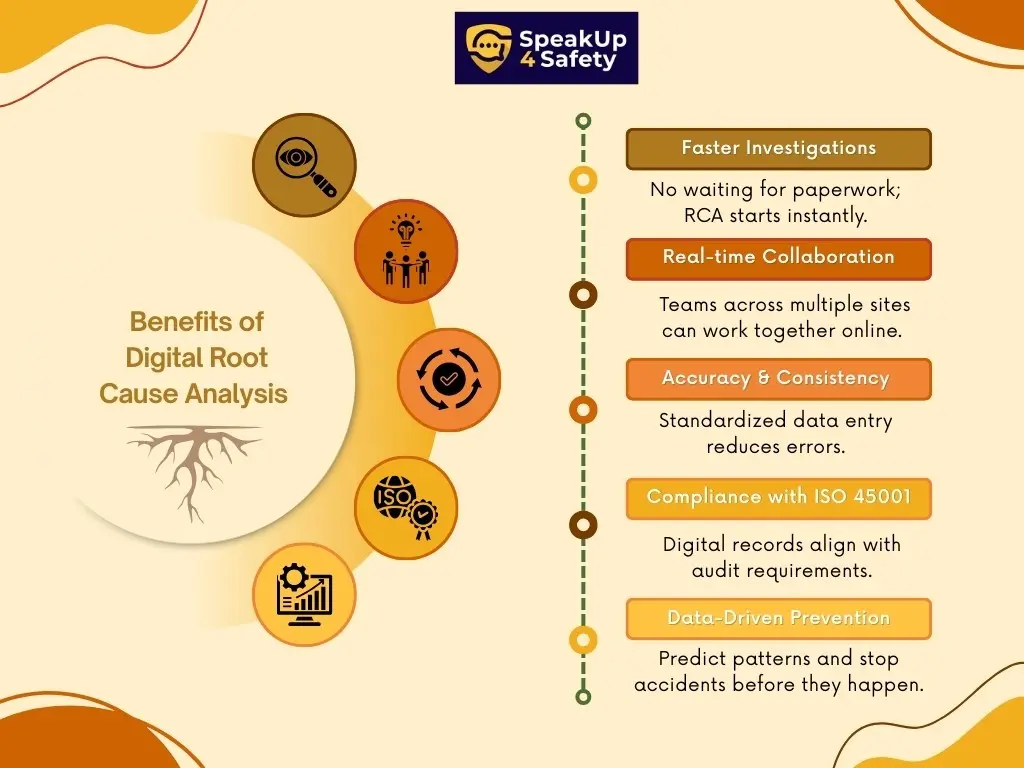
Root Cause Analysis Benefits with Digital Tools
Best Practices to Make RCA More Effective
Going digital with RCA is effective only if it’s implemented correctly. Here are proven best practices:
- Encourage Worker Participation via Mobile Reporting – Make it easy for employees to log hazards and incidents in real time. Simplicity leads to higher participation rates.
- Standardize RCA Templates Across Sites – Using the same digital forms, checklists, and diagrams ensures consistency, whether you’re analyzing an incident in a warehouse or on a construction site.
- Train Teams on Digital Tools – Even the best software is ineffective if people don’t know how to use it. Regular training sessions make sure investigators, supervisors, and frontline workers get the most out of RCA tools.
- Integrate RCA Findings into Safety KPIs – Use dashboards to connect RCA results with safety performance indicators like Lost Time Injury Frequency Rate (LTIFR). This ensures insights lead to measurable improvements.
- Automate Corrective Action Tracking – Assign tasks directly from RCA findings, track progress digitally, and set deadlines. This reduces the chance of corrective measures being forgotten or delayed.
- Link RCA to Training Programs – Feed lessons from RCA investigations into ongoing safety training. For example, if slips are recurring, update training modules to highlight proper floor maintenance and footwear requirements.
How SpeakUp4Safety Can Help
Root Cause Analysis (RCA) is only effective when it’s timely, structured, and backed by accurate data. This is where SpeakUp4Safety adds real value. The platform turns traditional, paper-heavy RCA into a streamlined digital process by:
- Capturing incidents instantly – Workers can report hazards or accidents through mobile devices, ensuring RCA starts with complete and real-time data.
- Guiding investigations step by step – Built-in digital templates help safety teams apply methods like the 5 Whys or Fishbone diagrams without missing key details.
- Automating corrective actions – Assign, track, and verify fixes so RCA doesn’t stop at identifying causes but also ensures long-term prevention.
- Delivering compliance-ready reports – Reports align with ISO 45001 and OSHA standards, making it easier to demonstrate due diligence during audits.
Solve incidents at the root, not just on the surface. SpeakUp4Safety helps you build a safety-first culture while staying compliant.
Conclusion
Root Cause Analysis is a powerful way to move beyond surface fixes and address the true causes of workplace incidents. When done digitally, RCA prevents repeat accidents, supports ISO 45001 and OSHA compliance, reduces costs from downtime and claims, and strengthens worker trust and engagement.
It also provides faster investigations, real-time visibility across sites, and ensures corrective actions are properly tracked.
With platforms like SpeakUp4Safety, organizations can turn investigations into lasting improvements, building a proactive safety culture where risks are solved at the root and safer workplaces become the standard.
Questions and answers on this topic
Do you have practical questions or want to go deeper into the topic? In this section we collect the most relevant questions asked by EHS professionals together with the official answers from the SpeakUp4Safety Team, to help you turn concepts into concrete actions.
Do you have a question about this topic?
Submit your question by email. It will be reviewed by our specialists and, if relevant for the community, published with an official response.
Privacy note: the information you provide will be used exclusively to respond to your request.