EHS software: from reaction to prevention and measurable ROI
For executive leadership, EHS software is not a safety add-on. Instead, it is a management capability that strengthens
operational resilience, improves governance, and actively reduces the
total cost of risk.
When organizations capture near misses and unsafe conditions systematically, prevention becomes a controllable operating model rather than a reactive response.
SpeakUp4Safety EHS software enables this shift by connecting early signals—near misses, unsafe conditions, and observations—
with disciplined execution. As a result, leaders manage prevention with the same rigor applied to quality, cost, and delivery.
What changes for leadership
- From anecdotes to evidence: leaders base decisions on trend signals and verified action completion.
- From compliance to performance: prevention becomes an execution system, not a reporting exercise.
- From lagging to leading control: exposure is reduced before incidents, claims, or downtime occur.
From reaction to prevention: the executive business value
Traditional safety management focuses on lagging outcomes such as incidents, injuries, and lost workdays.
Although these indicators remain necessary, they do not allow leaders to manage risk proactively.
Executives require forward-looking visibility into exposure trends, weak controls, and execution quality.
A prevention-driven model relies on early signals and disciplined follow-up.
Near miss reporting becomes strategically valuable when it delivers high-quality data,
prioritizes high-exposure areas, accelerates corrective actions, and verifies effectiveness.
At this point, prevention shifts from culture alone to measurable management control.
Operational continuity
- Fewer disruptions caused by incidents and emergency interventions.
- Earlier identification of weak signals and recurring hazards.
- Improved audit readiness through traceable, standardized workflows.
Financial performance
- Reduced direct costs: injuries, lost workdays, and insurance claims.
- Lower indirect costs: downtime, investigations, retraining, and reputational impact.
- More effective capital allocation toward controls with proven prevention value.
Worker participation as the foundation of prevention
Prevention cannot be designed exclusively in boardrooms or procedures.
Instead, it depends on active worker participation.
Frontline teams experience real operational variability every day—time pressure, equipment constraints, and non-routine tasks.
These conditions often generate weak signals long before incidents appear in statistics.
When workers report near misses quickly and without friction, organizations gain early intelligence on emerging risks.
These reports form the raw material of organizational learning,
allowing EHS and operations to detect patterns that incident-only systems never reveal.
Participation becomes sustainable when the system responds consistently.
Fast triage, clear ownership, respected deadlines, and visible feedback close the loop.
Over time, this creates a reinforcing cycle: more trust leads to more reporting, which drives better prevention outcomes.
ROI of EHS Software
A proactive approach is not only cultural but economic.
By preventing incidents before escalation, organizations reduce direct costs
such as injuries and lost workdays while limiting indirect costs
including downtime, investigations, reputational damage, and management distraction.
In a prevention-driven system, ROI becomes measurable through four execution levers:
reporting participation, risk prioritization, corrective action speed, and effectiveness verification.
When leaders manage these levers consistently, prevention becomes predictable and auditable.
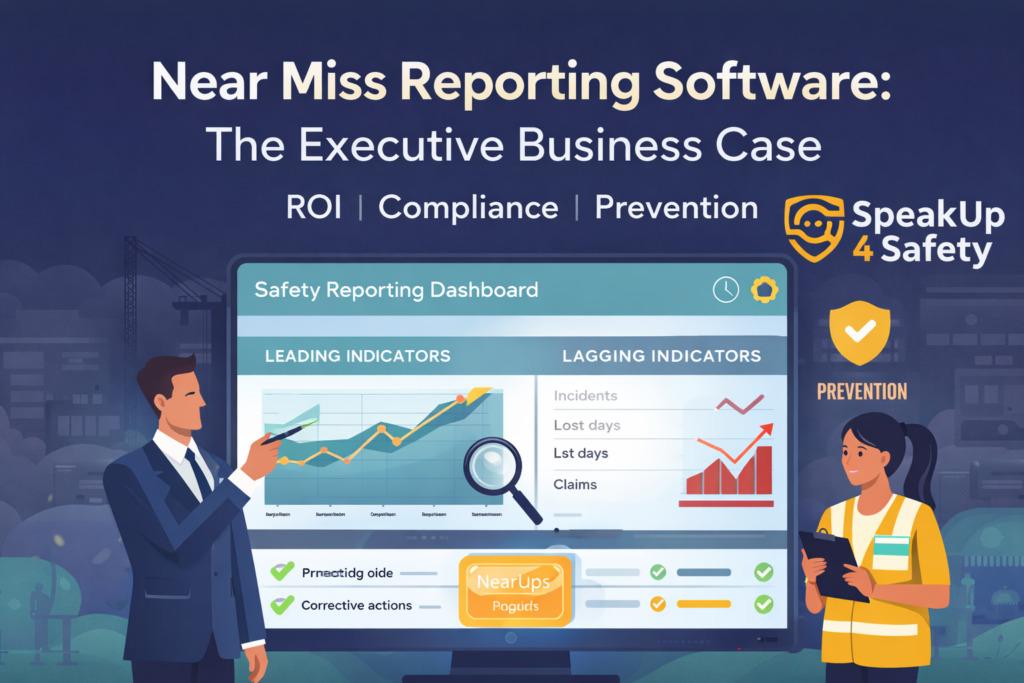
Dynamic safety dashboard for decision makers
SpeakUp4Safety supports this transformation through a
dynamic safety dashboard
that provides real-time visibility into safety performance across sites.
Instead of relying on retrospective reports, leaders continuously monitor exposure trends and execution quality.
Using this dashboard, organizations can compare
safety KPIs
by balancing lagging indicators with leading indicators such as near misses,
unsafe conditions, corrective action closure rates, and prevention effectiveness.
This integrated view enables evidence-based investment decisions.
ROI Calculator for Prevention-Driven EHS Leadership
Use this calculator to estimate annual cost avoidance from prevention. It translates incident reduction into economic impact
and keeps assumptions transparent.
Estimated annual prevention impact
Current annual incident cost: €0
Potential annual cost avoidance: €0
Payback time: — |
ROI: —
Enter your values and click “Calculate prevention impact” to generate an executive-ready ROI summary.
Questions and answers on this topic
Do you have practical questions or want to go deeper into the topic? In this section we collect the most relevant questions asked by EHS professionals together with the official answers from the SpeakUp4Safety Team, to help you turn concepts into concrete actions.
Do you have a question about this topic?
Submit your question by email. It will be reviewed by our specialists and, if relevant for the community, published with an official response.
Privacy note: the information you provide will be used exclusively to respond to your request.