An electrical safety audit helps prevent incidents caused by weak inspection routines, missing documentation, and aging infrastructure. Therefore, many organizations are upgrading audits to improve prevention and strengthen compliance.
When teams move from paper checklists to digital inspections, they improve data accuracy and reduce human error. Moreover, they can identify patterns faster and prioritize corrective actions before risk escalates.
With SpeakUp4Safety, you can digitize your audits so every inspection becomes faster, consistent, and fully traceable. As a result, you reduce electrical risk and keep evidence ready for internal reviews and external audits.
What Is an Electrical Safety Audit?
An electrical safety audit is a structured assessment that identifies hazards such as electric shock, short circuits, equipment failures, and fire risks before they cause harm. In addition, it supports compliance by applying a defined checklist and keeping documented evidence of findings and actions.
When teams use digital tools, they can record findings in real time, assign corrective actions immediately, and verify closure with clear accountability. Consequently, audits support continuous improvement instead of one-time paperwork.
The AT Electrical Safety form, created by SpeakUp4Safety, streamlines inspections with guided questions, photo evidence, and traceable follow-up. In this guide, you’ll learn how it works, who uses it, and how digital audits strengthen safety performance.
Why Electrical Audits Matter for Prevention and Compliance
Electrical audits are a core element of many Occupational Health and Safety Management Systems. They help verify that installations, protective devices, and maintenance practices remain safe and aligned with applicable requirements.
For reference, many organizations align controls and practices with widely used guidance such as OSHA electrical safety guidance and NFPA 70E. This approach improves audit readiness and strengthens risk control consistency.
Key objectives include:
- Hazard identification: Detect unsafe conditions such as insulation degradation, faulty earthing, damaged cables, or overloaded circuits. As a result, teams reduce exposure early.
- Standards alignment: Verify that installations and maintenance activities meet applicable requirements and internal procedures. Moreover, teams can demonstrate evidence during audits.
- System integrity: Check protections, controls, and critical equipment conditions to reduce downtime and prevent failures.
- Documentation and traceability: Keep verifiable records of inspections, test results, and corrective actions for audits and certifications.
- Corrective and preventive action (CAPA): Assign owners, set deadlines, and track closure. For complex issues, reinforce learning with a structured Root Cause Analysis (RCA).
Ultimately, a well-run electrical safety audit reduces human error, improves reliability, and supports consistent compliance across sites.
How SpeakUp4Safety Improves Inspection Quality
SpeakUp4Safety modernizes inspections by digitizing data capture and follow-up. Consequently, teams identify risks faster, document evidence consistently, and improve decision-making with real-time visibility.
Key capabilities include:
- Customizable digital forms: Tailor the AT Electrical Safety form to match your site’s workflow and requirements.
- On-site evidence capture: Collect photos, notes, and details in the field for stronger traceability.
- Corrective Improvement (CI) tracking: Open CI cards, assign owners, and monitor deadlines to prevent overdue actions.
- Dashboards and reports: Review trends and recurring issues so you can prioritize prevention.
As a result, teams shift from “checking the box” to managing electrical risk proactively.
Who Uses the AT Electrical Safety Form
The AT Electrical Safety form supports multiple roles. Therefore, inspections become collaborative and consistent across departments.
- Lead Auditors / Safety Officers
- Coordinate inspections and ensure data completeness.
- Record metadata (date, time, location, participants) to strengthen traceability.
- Auditors / Inspection Team Members
- Perform detailed checks on workstations and equipment.
- Capture findings with photos, notes, and checklist answers.
- Operators / Employees
- Share frontline input on real working conditions.
- Report hazards observed during daily operations.
- Management / Compliance Teams
- Review findings and CI cards.
- Track closure status via dashboards and reports.
With one shared system, inspections become more consistent and corrective actions become easier to manage.
How to Run the Audit with the AT Electrical Safety Form
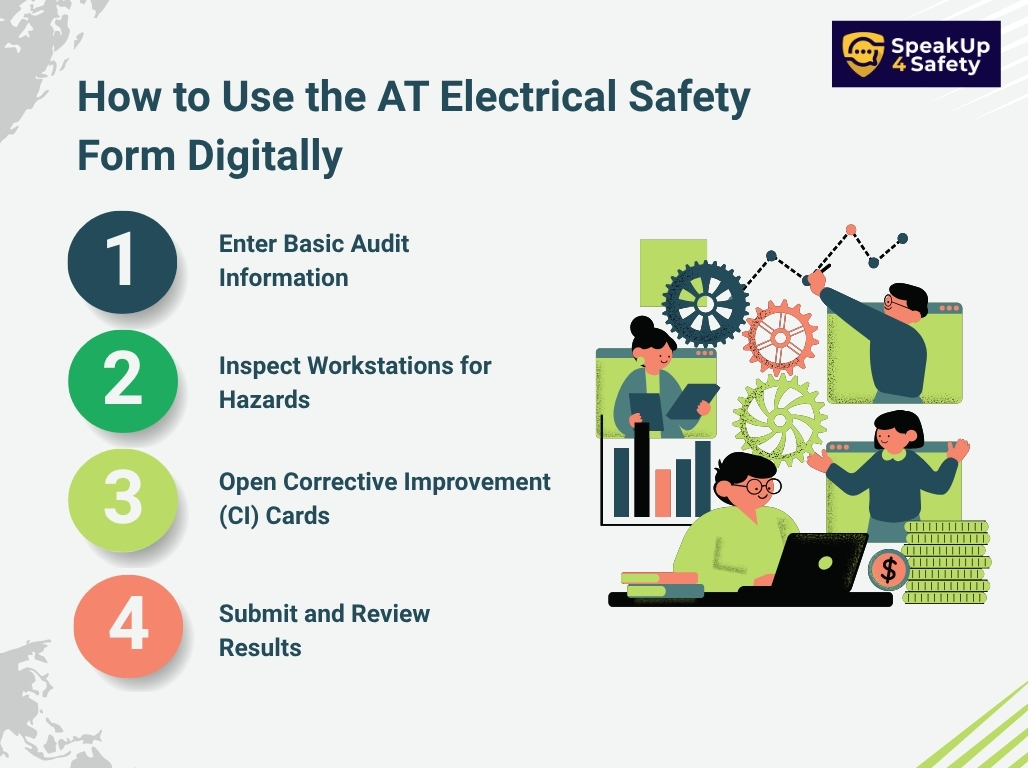
- Enter inspection information
- Select the inspection date and time.
- Record lead auditor, participants, and location for traceability.
- Inspect workstations and equipment
- Check for exposed live parts and damaged protections.
- Add photos and notes to document hazards clearly.
- Verify emergency stops and safety devices are functional.
- Open CI cards for corrective action
- Flag hazards and assign responsibilities.
- Set deadlines and follow up until closure.
- Submit and review results
- Make results available immediately to supervisors and management.
- Review evidence and CI status via dashboards.
- Export reports for compliance and internal monitoring.
Benefits of Digitizing Electrical Inspections
- Consistency across sites: Standardized checklists reduce variation and improve audit quality.
- Better accuracy and accountability: Required fields and photo evidence reduce omissions.
- Faster reporting: Managers review findings immediately and assign actions without delays.
- Efficient tracking: Clear owners and deadlines reduce repeat issues.
- Proactive safety culture: Teams act early on hazards and strengthen continuous improvement.
Industries That Benefit Most
- Manufacturing: Audit machinery, panels, and high-load installations to reduce incidents and downtime.
- Construction: Evaluate temporary power and portable equipment to prevent avoidable exposure.
- Offices and data centers: Monitor distribution panels and critical rooms to protect continuity.
- Healthcare: Inspect sensitive equipment and critical systems to protect patients and staff.
Conclusion
Electrical risks affect every workplace. However, a systematic electrical safety audit helps prevent incidents, improves reliability, and supports compliance. Therefore, a digital approach makes audits faster, more consistent, and easier to verify.
By using SpeakUp4Safety to digitize the AT Electrical Safety form, teams standardize inspections, capture evidence with photos and notes, and track corrective actions efficiently. As a result, auditors, operators, and managers work together to build a proactive safety culture.
Ready to digitize your next electrical safety audit? Get started with SpeakUp4Safety today.
Questions and answers on this topic
Do you have practical questions or want to go deeper into the topic? In this section we collect the most relevant questions asked by EHS professionals together with the official answers from the SpeakUp4Safety Team, to help you turn concepts into concrete actions.
Do you have a question about this topic?
Submit your question by email. It will be reviewed by our specialists and, if relevant for the community, published with an official response.
Privacy note: the information you provide will be used exclusively to respond to your request.